What Margaret does
A counselling practice that rents rooms by the hour.
Margaret runs Willow House in Leeds, a converted Victorian house with eight rooms. Seven are counselling rooms, each with two chairs, a lamp and a box of tissues. The eighth is the Group Room upstairs, used for workshops and training, and it is bigger, so it costs a little more.
She does not employ the therapists. Forty of them rent rooms from her: counsellors, psychotherapists, a couples therapist, a play therapist on Saturdays. Each brings their own clients. What Margaret sells is time in a room.
A counselling session lasts fifty minutes, and the therapist then has ten minutes before the room is needed again: the client leaves, notes are written, the next client is fetched. So every booking is a whole hour, starting on the hour, nine in the morning to nine at night. The evenings fill first.
Her therapists come in three kinds. Regulars like Tom, who see clients most days and often take a whole morning or evening at once. Occasional therapists, who book an hour when a client needs one. And students like Amira, still qualifying, who need supervised client hours for their course; Margaret charges them less, and they fill the quiet daytime hours.
What she charges
| What is booked | Qualified therapists | Students |
|---|---|---|
| A session (one hour) | £10 (Group Room £15) | £8 (Group Room £12) |
| A morning, afternoon or evening (four hours) | £36 (Group Room £54) | £29 (Group Room £43) |
| Four blocks a month | £120 a month | Not offered |
The blocks reward her regulars for booking in bulk: four hours for the price of three and a half. The plan gives Margaret a steady £120 a month from each regular who takes it, and gives them four half-days a month without thinking about it.
The words on this page
| Word | What it is | What it does | Why it is useful |
|---|---|---|---|
| Resource | Anything people book. For Margaret, her rooms. | Gives each one its own diary, so nobody can double-book it. | Everything else, prices included, is built on your resources. |
| Session | One booking slot: for Margaret, an hour starting on the hour. | Sets the grid people book on. | Bookings line up, with no awkward gaps between them. |
| Rate card | A price list. | Sets what each resource costs for the people on it. | Different people can pay different prices for the same room: qualified therapists and students. |
| Default card | The price list everyone starts on. | Every new member is put on it automatically. | If everyone pays the same, it is the only one you need. |
| Price (the app's Add product) | One way of paying for a resource: a session, or a block. | Tells me what to charge, and shows the member before they book. | One room can be sold by the session and by the morning, and I pick whichever fits. |
| Block | Several sessions in a row from a fixed start, sold as one, like a morning. | Books the whole stretch in one go, at one price. | A better price for a longer booking, in one tap. |
| Group | Resources a member can have only one of at a time. | Lets someone book things from different groups together. | For places where people need two things at once. Margaret does not need one. |
| Membership plan | A monthly fee that includes so many bookings. | Covers those bookings at £0 and charges anything more at the normal price. | Regular income for you, and a reason for members to book more. |
| Member | Someone who books: for Margaret, each therapist. | Puts their name on their bookings, their price list on what they pay, and their bills in one place. | I know who is in which room, and they can book from their own phone. |
| Statement | A member's bill for the month. | Lists their bookings, what their plan covered, and the total. | One bill a month, and nobody chased. |
The order, every time: the resources, then their prices, then, only if you need them, more rate cards, groups and plans. Then your members, and each person onto their price list. Members are part of setting up, not something for later: until I know who books, nobody can. The longer story behind these words is inHow pricing works (bookwithdoris.com/guides/how-pricing-works).
Step 1
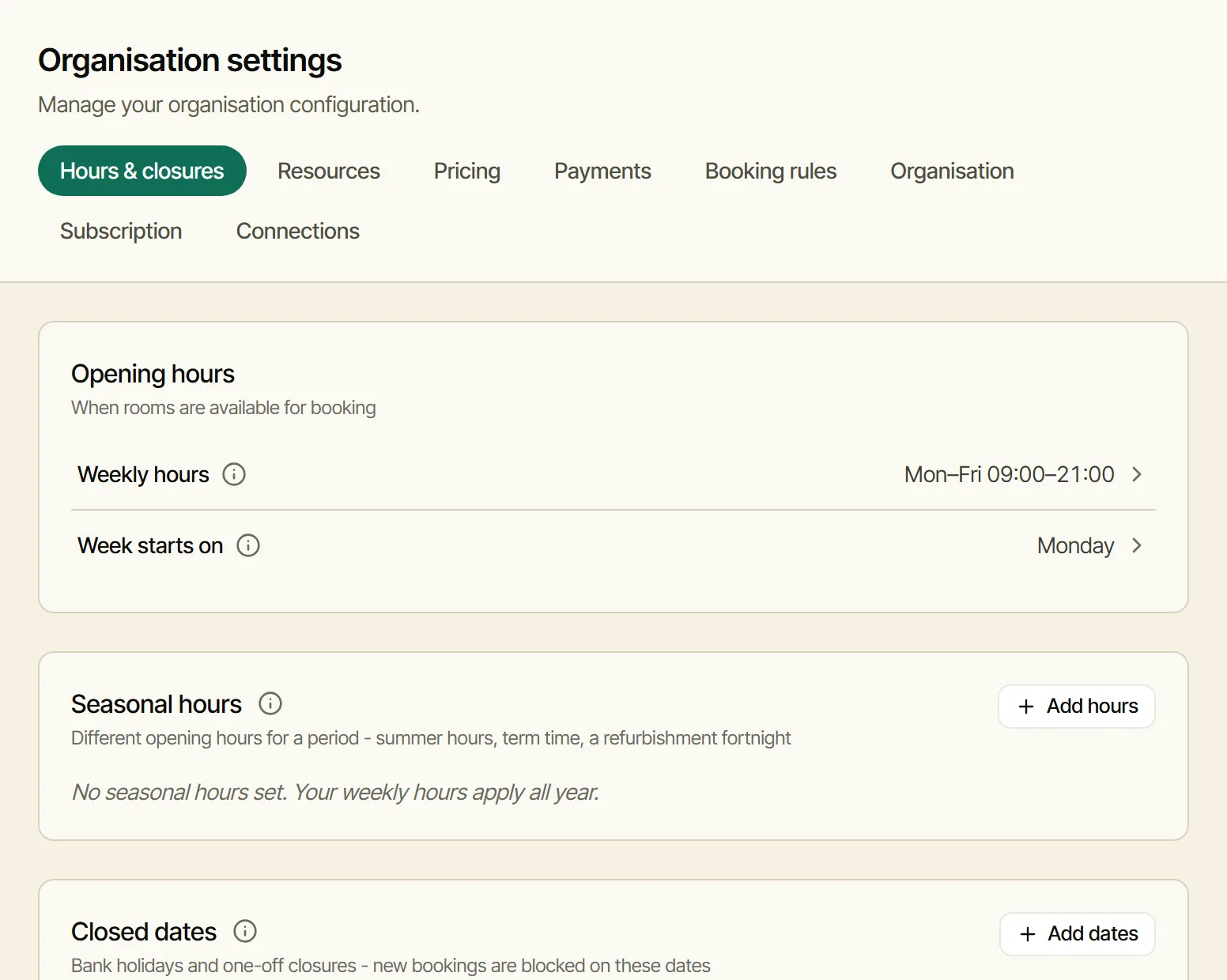
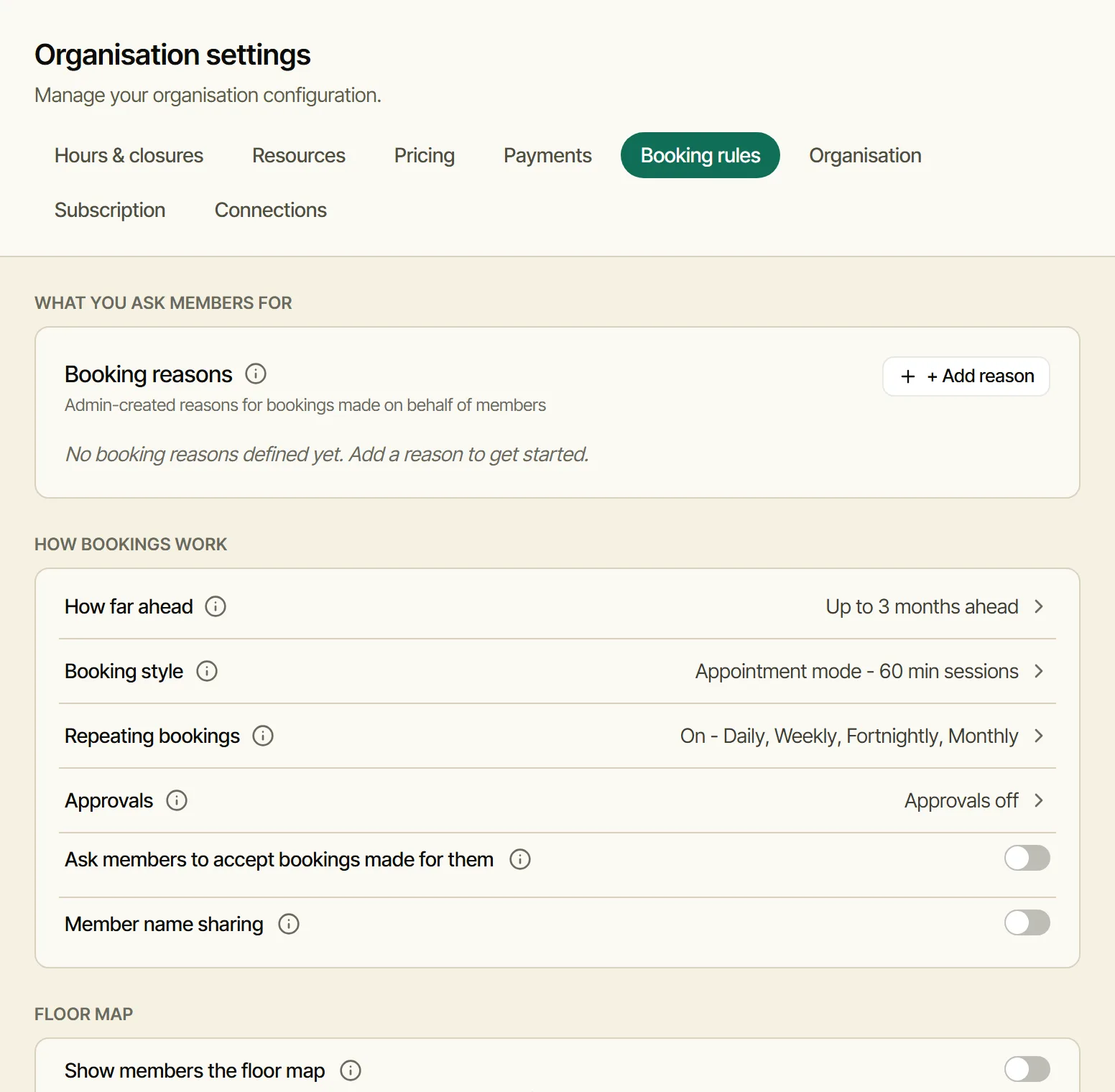
Opening hours, and how people book.
Why: I need to know when the house is open and what a booking looks like before anything else.
Where: Settings, Hours & closures: nine till nine. Then Settings, Booking rules, Booking style: Appointment mode, sessions of 60 minutes.
Step 2
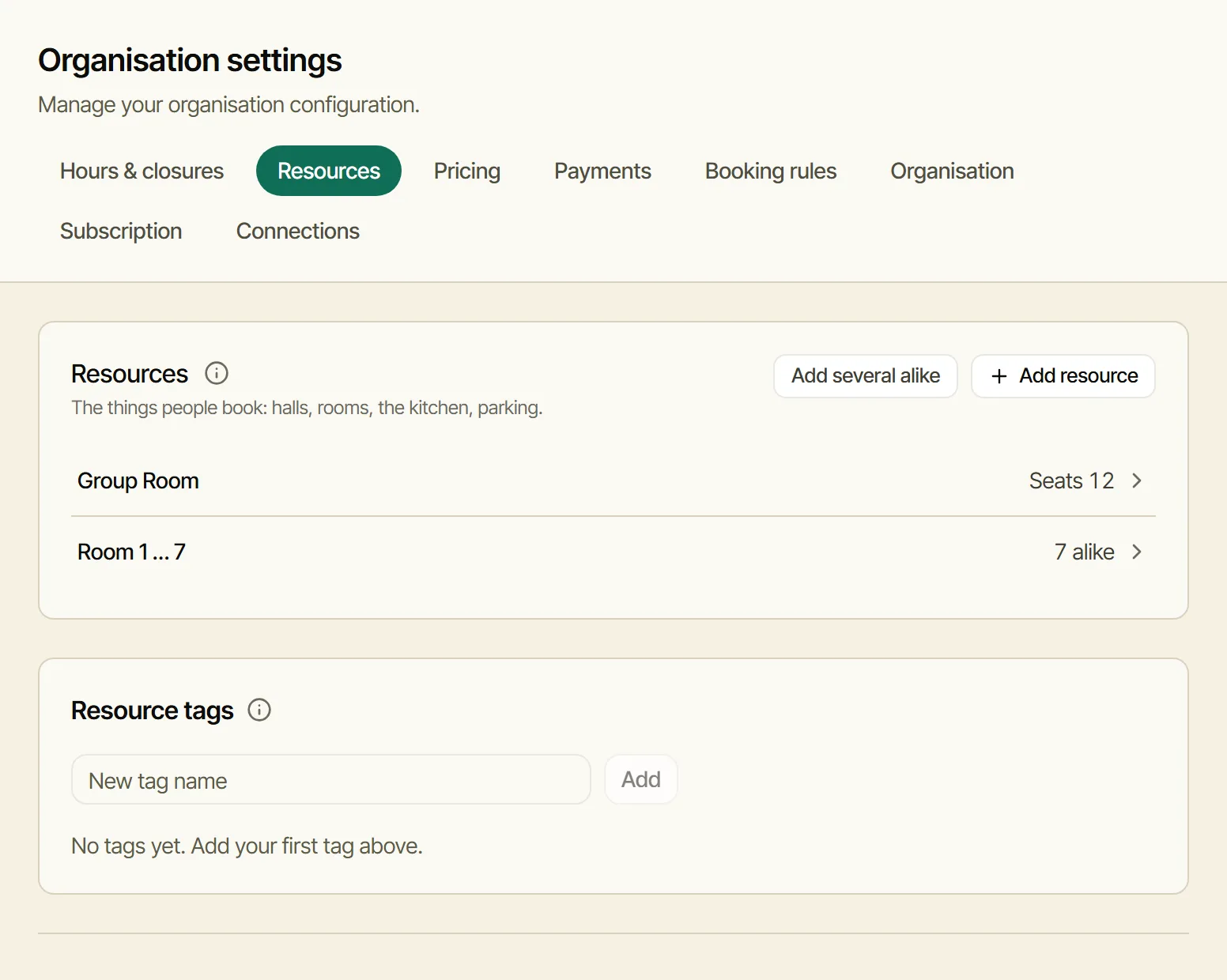
The rooms.
Why: each room gets its own diary.
Where: Settings, Resources. Add several alike makes Room 1 to Room 7 in one go; Add resource adds the Group Room.
Step 3
The prices, on the Default card.
Why: this is what a qualified therapist pays, and everyone starts here.
Where: Settings, Pricing, with Default chosen. On each room, Add product: first Per session at £10; then three times Block of sessions, starting at 9:00, 13:00 and 17:00, four sessions each, called Morning, Afternoon and Evening, at £36. The Group Room gets the same, at £15 and £54.
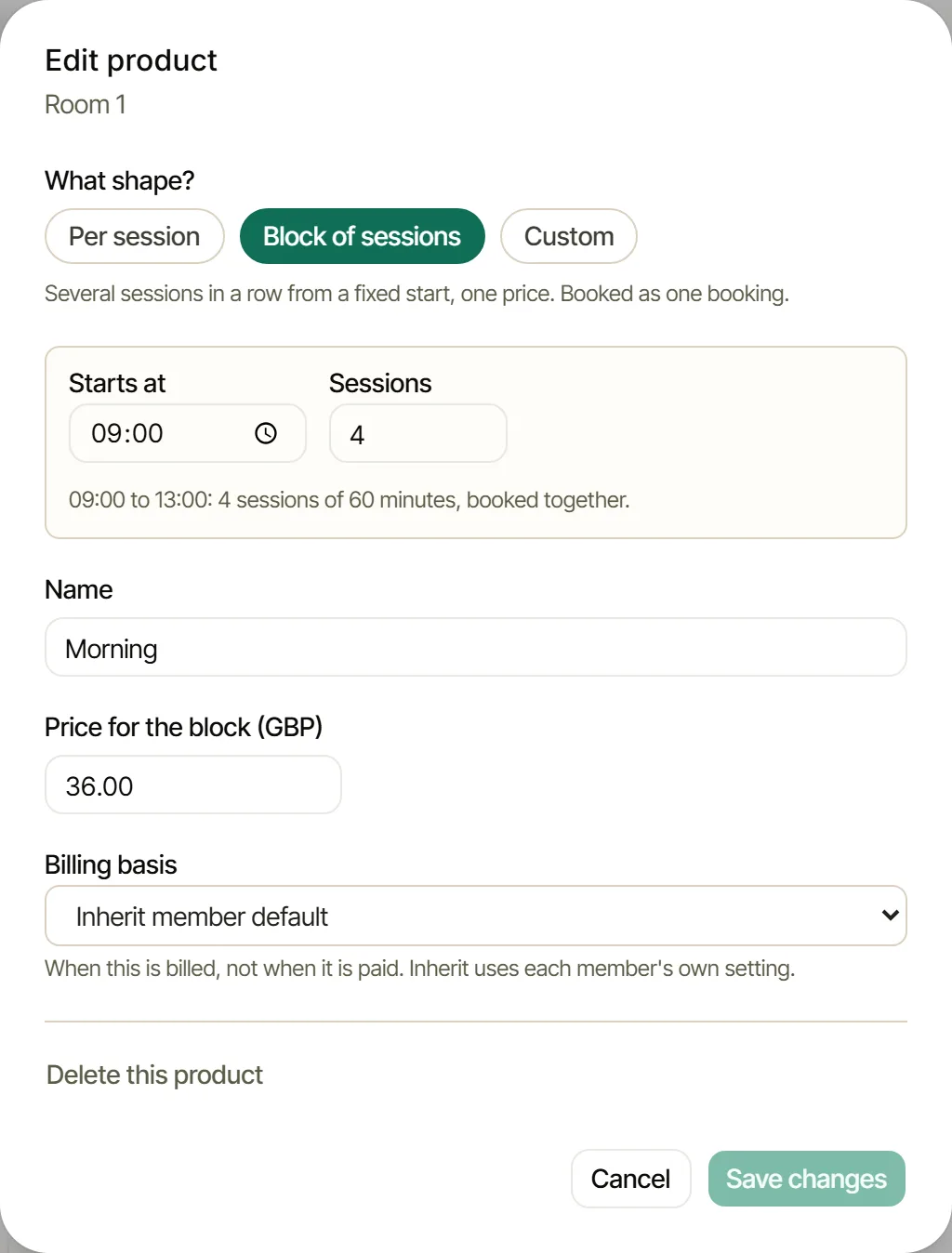
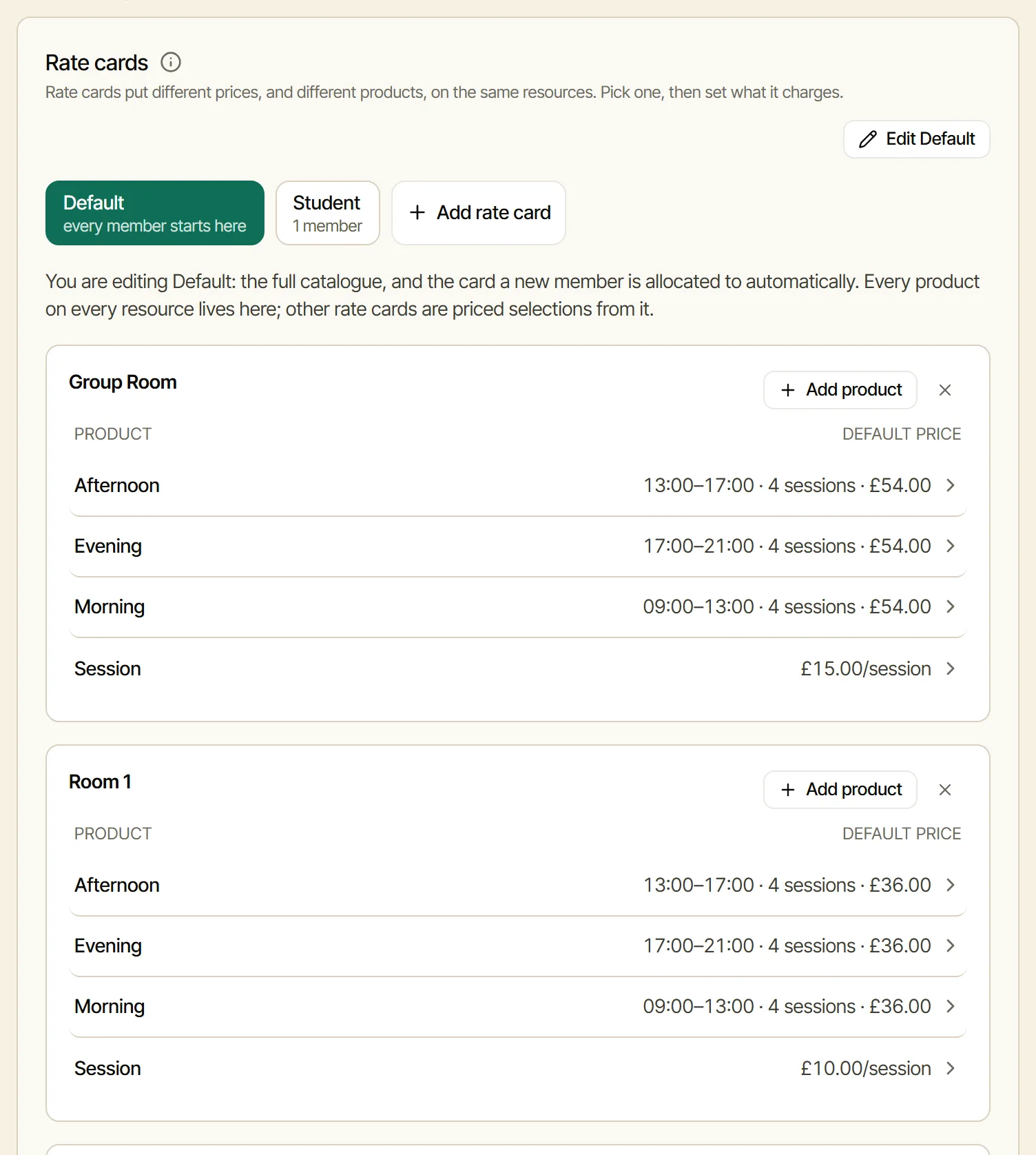
There is no all-day block on purpose: a full day is a morning and an afternoon, booked together. Step 5 says why.
Step 4
A second price list, for students.
Why: students pay less for the same rooms.
Where: Settings, Pricing, Add rate card. Margaret calls it Student, and leaves Start from Default on, so every room and price comes across. Then on the Student card she opens each price and changes it: £8 a session, £29 a block, and the Group Room £12 and £43. Call yours whatever fits: Student, Trainee, Concession.
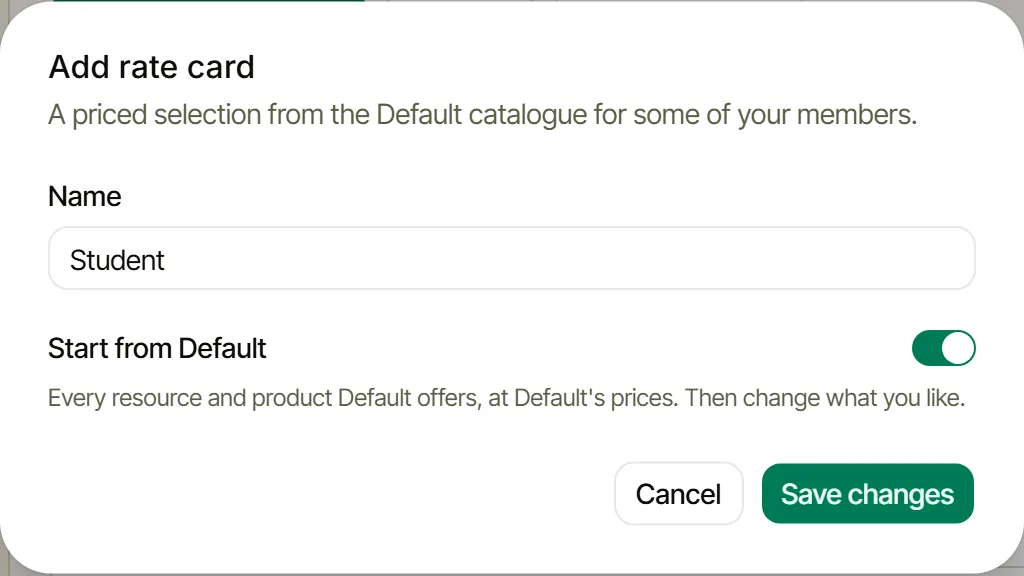
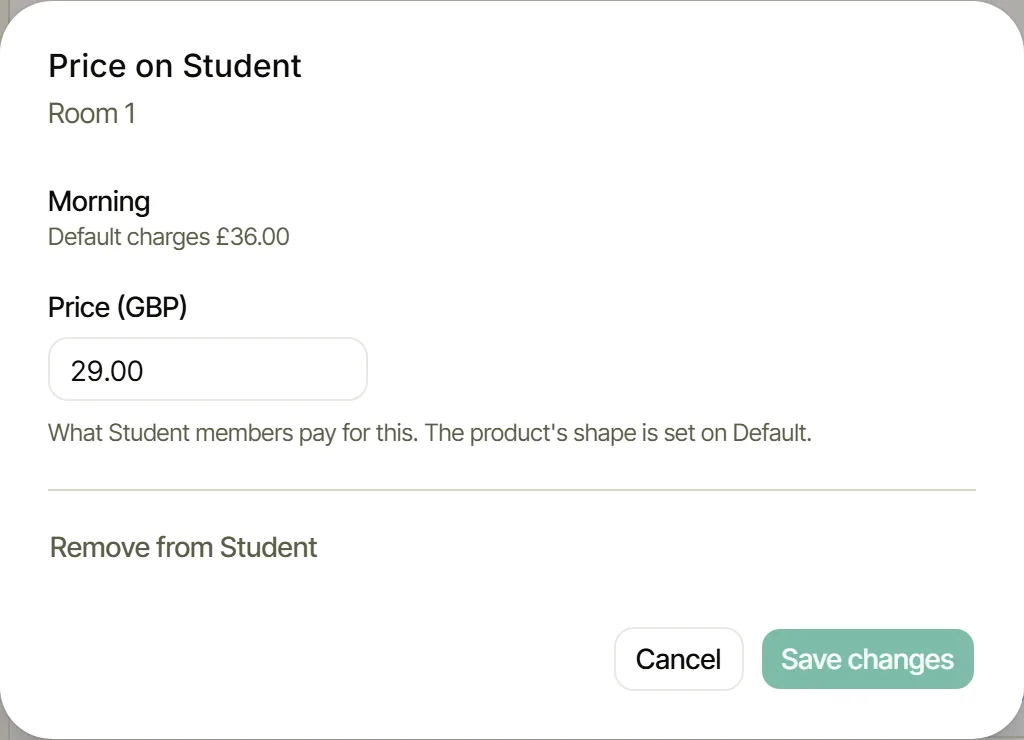
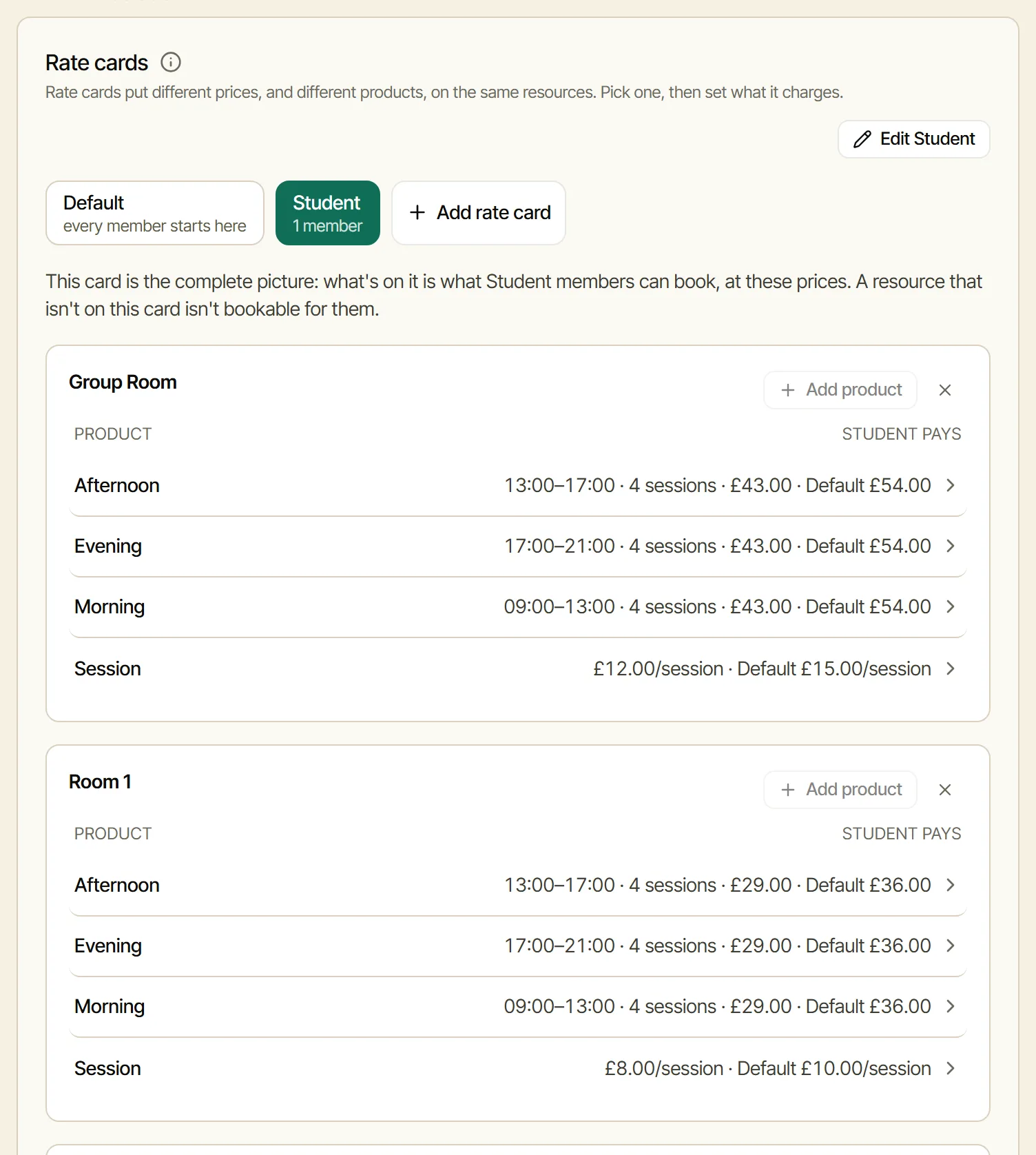
Two ways to run it. The simplest: qualified therapists stay on Default and only students move. Or, to make it obvious at a glance, copy Default twice, into Qualified and Student, and put everyone on one or the other. If you do that, remember every new member starts on Default, so you move each one across when you add them.
Step 5
No groups, then a plan for qualified therapists.
No groups. A therapist only ever needs one room at a time, and that is what I assume when there are no groups. Groups are for places where someone needs two things at once, like a hall and its kitchen.
Why a plan: a steady monthly income for Margaret, and a reason for her regulars to book more.
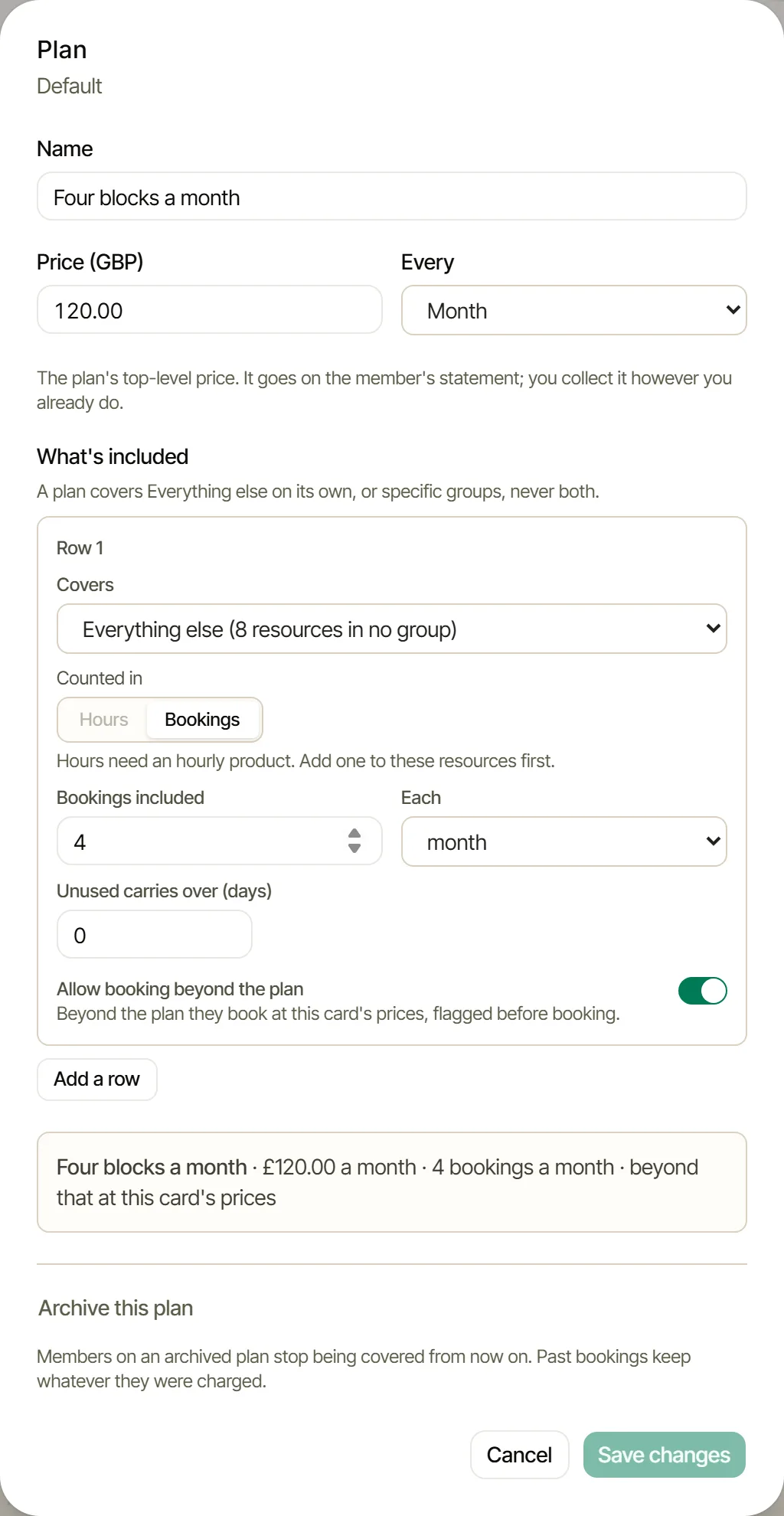
Where: Settings, Pricing, with Default chosen, Membership plans,Add plan. Margaret calls it Four blocks a month, £120 every month. It coversEverything else, which means every room in no group, so she needs no group first. It is counted in Bookings: four a month. Allow booking beyond the plan stays on, so a fifth block is simply charged at the block price.
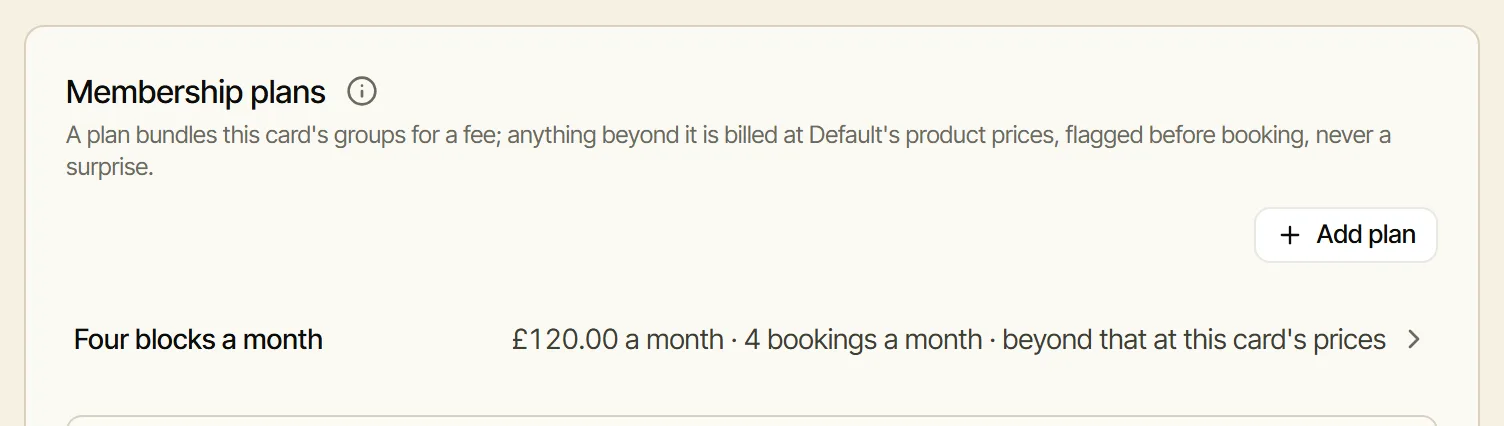
What the plan does, and does not do:
- It lives on the Default card, so only people on Default can have it. I refuse it to anyone on the Student card.
- Every block counts as one booking. A full day is a morning and an afternoon, so it counts as two, which is why there is no all-day block.
- Single sessions are never part of it: they are always £10.
Step 6
Add the people who book.
Why: I need to know who is booking each room. Their name goes on the booking, their price list sets what they pay, and their bookings come together on one bill. That is why adding your members is part of setting up, not something to do later: until they are in, nobody can book.
What you need: each person’s email address. That is all. You can paste several at once, separated by commas.
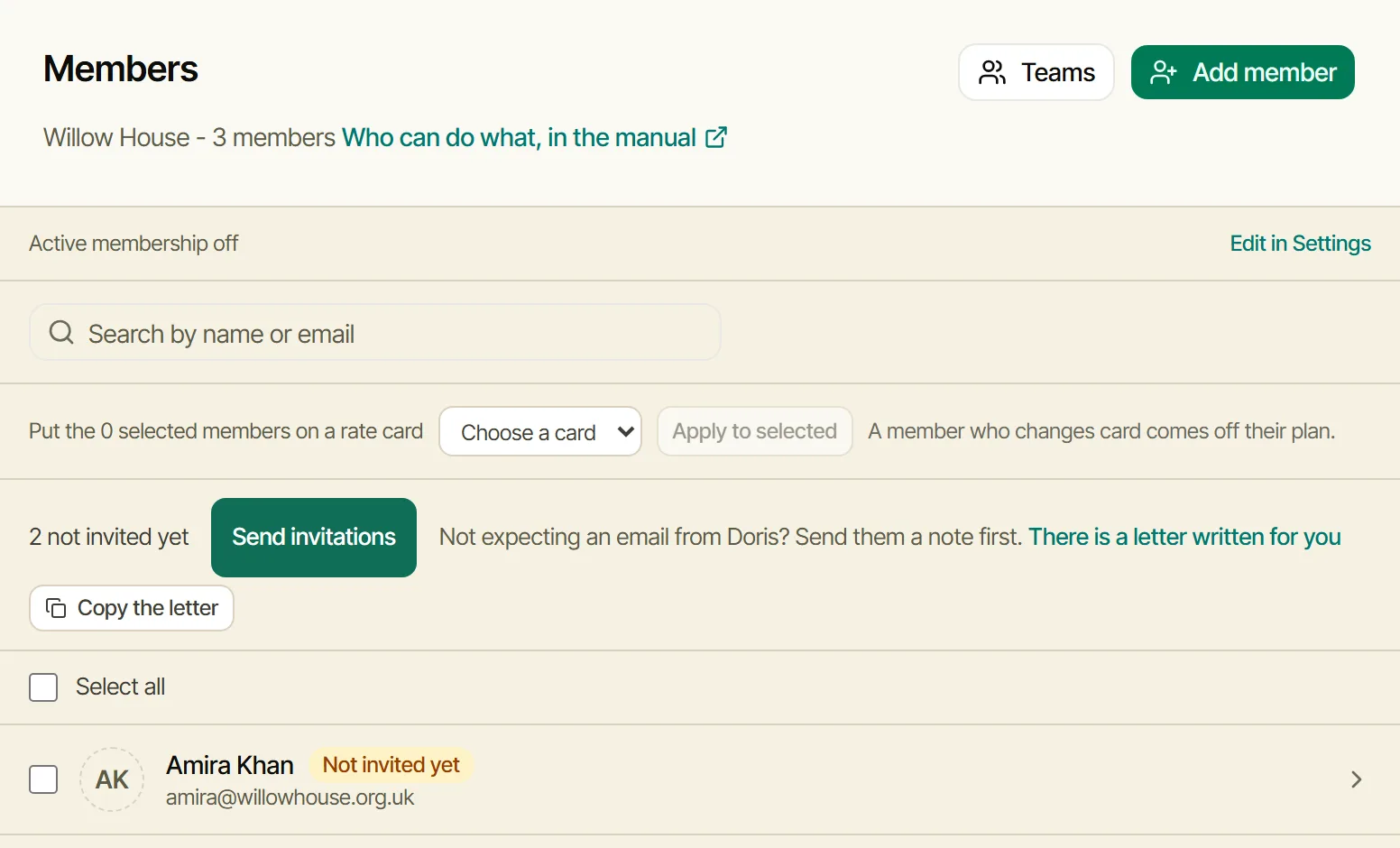
Where: the Members page, Add member. UnderWelcome email, choose Hold it until I’m ready. Each person is added straight away and told nothing yet. Margaret can book for them, put them on the right price list and get the diary ready first.
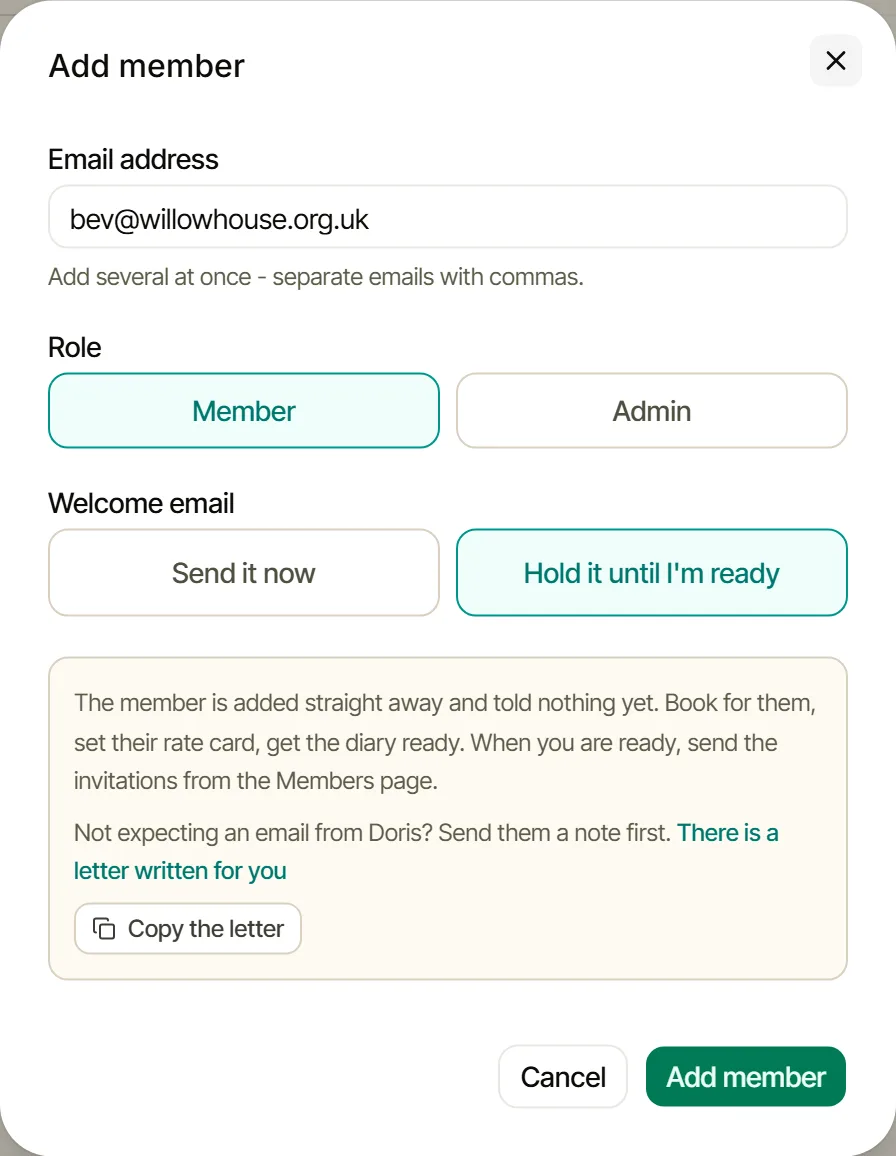
When she is ready: the Members page shows everyone still waiting as Not invited yet, and Send invitations sends their welcome emails, to everyone waiting or just the people she ticks. I never send a held email on my own. If they are not expecting to hear from me, there is a letter written for you to send them first. More inAdding your members (bookwithdoris.com/guides/inviting-members).
Step 7
Everyone onto their price list.
Where: the Members page. Qualified therapists need nothing: they are already on Default. Students: tick them, then under Put the selected members on a rate card choose Student. Tom's plan goes on his own member page.
The month
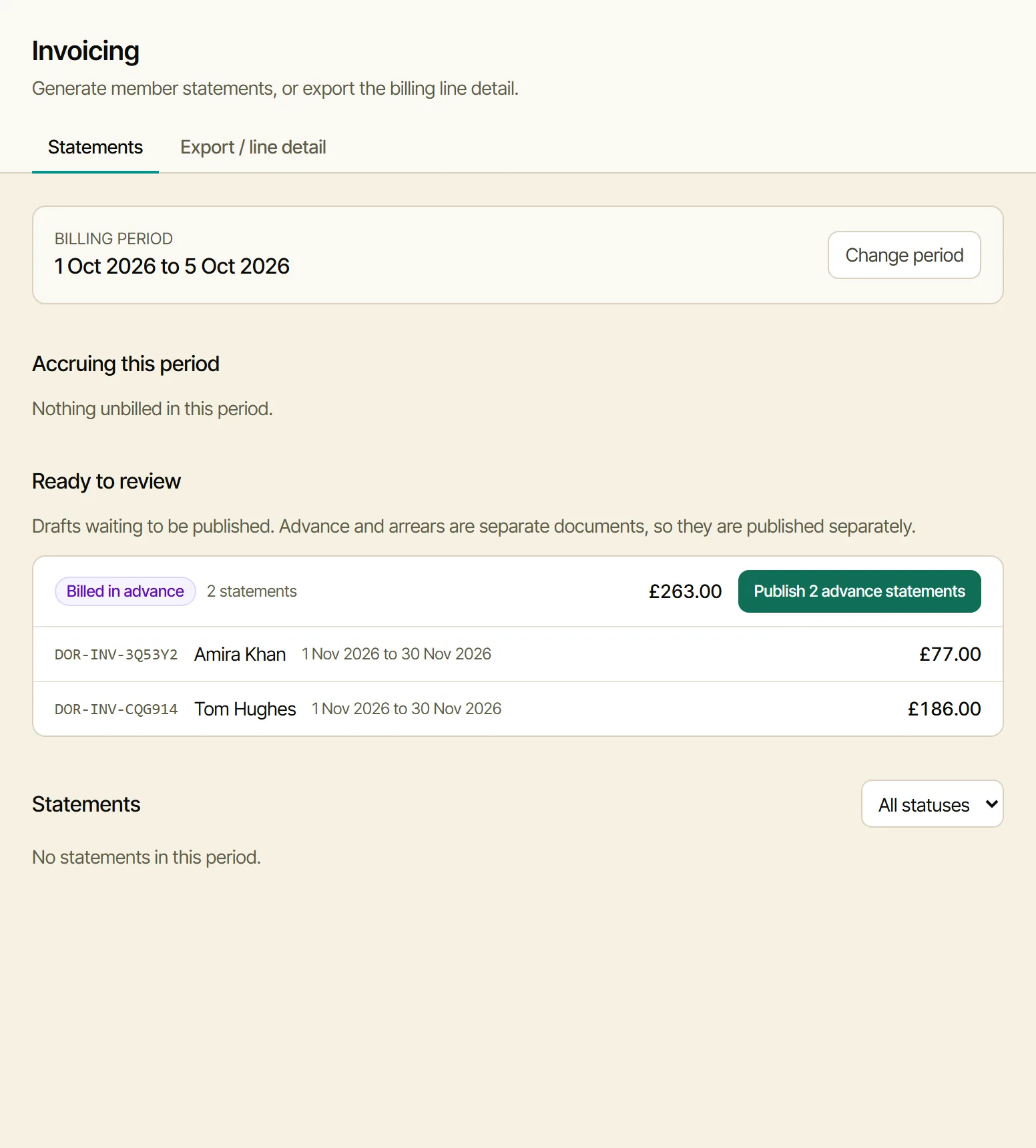
What Tom and Amira pay.
Tom books a full day (a morning and an afternoon), two more mornings, an evening, and three single sessions. Amira books six sessions and a morning.
| Tom's statement | Amount |
|---|---|
| Membership: Four blocks a month | £120 |
| The full day and two mornings: four blocks, Included | £0 |
| The evening, a fifth block | £36 |
| Three sessions at £10 | £30 |
| Total | £186 |
| Amira's statement | Amount |
|---|---|
| Six sessions at £8 | £48 |
| A morning | £29 |
| Total | £77 |